Ivan Nikolaevich Ponyrev
Ivan Nikolaevich Ponyrev, who writes under the pseudonym Homeless, is a poet and a member of the Massolit literary association. He is the first major character introduced in the novel and undergoes a profound transformation from a dogmatic Soviet poet to a tormented witness of supernatural truth, ultimately becoming a disciple of the Master and a historian haunted by the spring full moon.
Identity and Introduction
Ivan Nikolaevich Ponyrev is a broad-shouldered young man with tousled reddish hair, dressed in a cowboy shirt, wrinkled white trousers, and black sneakers. He writes under the pseudonym Homeless and is a member of Massolit. At the beginning of the novel, he is commissioned by the editor Mikhail Alexandrovich Berlioz to write a long anti-religious poem for the next issue of his journal. Ivan's portrayal of Jesus is described as "completely alive, the once-existing Jesus, though, true, a Jesus furnished with all negative features," which displeases Berlioz, who wants to prove that Jesus never existed. Ivan listens attentively to Berlioz's lecture on ancient historians and mythology, fixing his pert green eyes on him, and merely hiccups from time to time, cursing the apricot soda under his breath.
Encounter with Woland and the Death of Berlioz
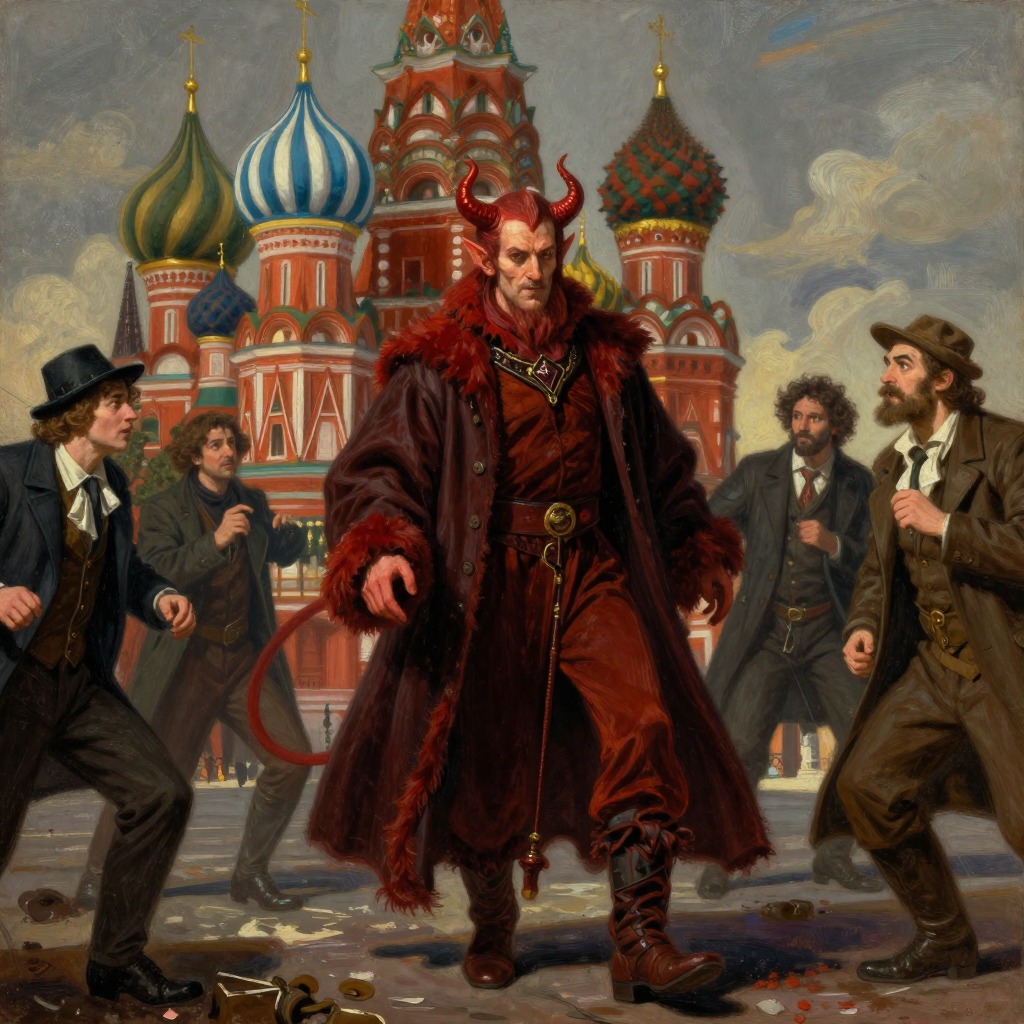
At the Patriarch's Ponds, Ivan and Berlioz encounter a mysterious foreigner who introduces himself as a specialist in black magic. The foreigner, Woland, astounds them by predicting Berlioz's death, stating that his head will be cut off by a Russian woman, a Komsomol girl, and that the meeting at Massolit will not take place because Annushka has already spilled sunflower oil. Ivan, initially thinking the foreigner is a spy or a madman, becomes increasingly agitated. When Berlioz is indeed decapitated by a tram-car, Ivan realizes the foreigner's prediction was accurate. He chases after Woland, who is accompanied by a long checkered man (Koroviev) and a huge black cat (Behemoth). The chase leads Ivan through the streets of Moscow, where he loses his clothes while swimming in the Moscow River and ends up at Griboedov's restaurant in his underwear, carrying a candle and a paper icon. There, he causes a scandal, hitting a man and being subdued by waiters before being taken to Professor Stravinsky's psychiatric clinic.
Confinement and Transformation in the Clinic
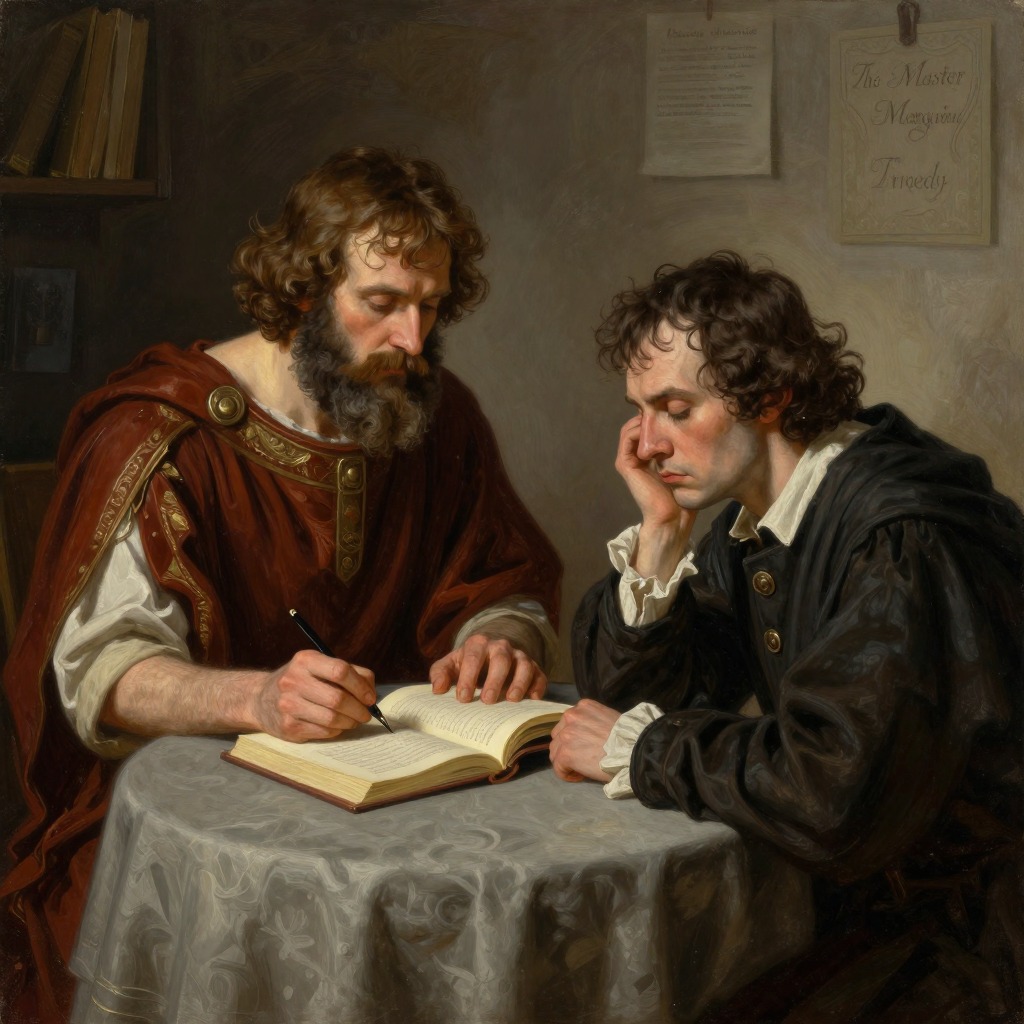
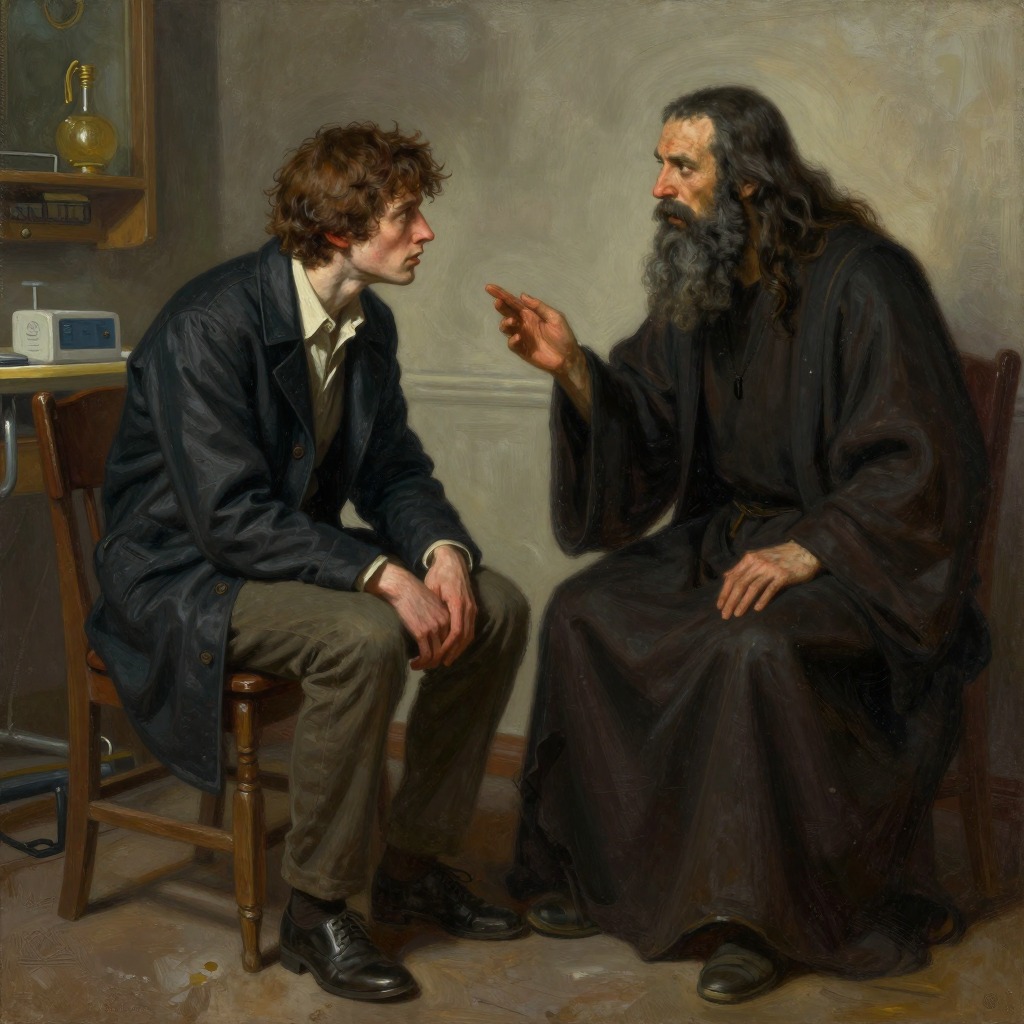
In the clinic, Ivan is diagnosed with schizophrenia and given injections. He initially resists, attempting to escape and calling the police to catch the consultant. However, under the care of Professor Stravinsky, who advises him to write a statement and remain calm, Ivan begins to change. He reflects on his actions and realizes the absurdity of his chase. During a stormy night, he is visited by a mysterious guest from the balcony, who turns out to be the Master. The Master tells Ivan about his own novel about Pontius Pilate and his love for Margarita. Ivan learns that the Master is also in the clinic because of his novel. The Master reveals that Woland is Satan and that Ivan's encounter with him was real. Ivan, deeply impressed, promises to stop writing poetry and becomes the Master's disciple. He learns that the Master's novel was rejected by editors and critics, leading to his mental breakdown and the burning of his manuscript.
Relationships and Conflict
Ivan's relationship with Berlioz is one of professional subordination, but after Berlioz's death, Ivan begins to question his own beliefs. His encounter with Woland shatters his atheistic worldview and leads to his mental crisis. In the clinic, Ivan forms a deep bond with the Master, who becomes his mentor. The Master tells Ivan about his love for Margarita and his persecution by critics like Latunsky, Ariman, and Mstislav Lavrovich. Ivan sympathizes with the Master and vows to continue his work. Ivan also interacts with Professor Stravinsky, who treats him with a combination of authority and kindness, helping him to calm down and accept his situation.
Change and Ending
Ivan undergoes a complete transformation. He renounces poetry, calling his own work "monstrous," and promises the Master never to write again. He becomes a historian, as revealed in the epilogue, where he is described as a professor who "knows everything" about the events of that spring. However, he is still haunted by the supernatural. Every year, with the coming of the spring full moon, he returns to the Patriarch's Ponds, where he experiences a recurrence of his visions. He sees the same characters—Woland, Koroviev, Behemoth, and the Master—and relives the events of that night. He becomes restless and anxious, unable to find peace. The epilogue states that he is an "uneasy inhabitant of 'normal' reality," and that each year he returns to the parable which for this world looks like folly.
Narrative Role and Evaluation
Ivan Homeless serves as the touchstone character of the novel. He is present at the beginning, is radically changed by his encounters with Woland and the Master, becomes the latter's disciple, and appears finally in the epilogue. His journey from a confident Soviet poet to a tormented historian mirrors the novel's central themes of truth, faith, and the consequences of encountering the supernatural. His transformation is a key example of how the novel's characters are forced to confront a reality beyond the mundane. Ivan's final state—a historian who knows everything but is still haunted—underscores the novel's exploration of the limits of reason and the persistence of the irrational.